When it comes to Statistics…question EVERYTHING!

“There are three kinds of lies: lies, damned lies, and statistics.” – Mark Twain

So, I was browsing the business articles when I came across an article (Bloomberg) that states, “Your pay is likely going down next year.”  Oh?  Well, you’ve caught my attention.  Is my company going to ask for money back?  Will they give me a new salary offer letter at a lower price?  Is this related to tax cuts and tariffs and complex math to show how much my purchasing power decreases although the headline clearly states “my pay” leading me to believe the paycheck I receive will literally be for less money?  I must know!  In the article it says, “In 2017, companies allocated 15.7% of their total budgets to salary and bonuses. That number dropped to 15.5% this year, and employers are planning on budgeting just 15.2% on pay next year.”  The article goes on to tell the reader that companies are yanking money from the budgeted money for bonuses and reallocating that to budgeted salaries to attract top talent.  Which should not affect anyone that already has a salary and bonus percentage agreed to.  I don’t want to dissect the meat of this article, but rather focus on the very vague statistics of it.  Clearly from the comments most people only read the headline and decided they were angry (shakes fist in the air).  Thanks Trump!  Thanks Obama!  A few people actually read the headline, but no one questioned the veracity of these statistics.  That’s what troubled me.  I work with numbers on a daily basis.  I’ve had jobs that were very statistically based leading me to use pareto charts, multiple variable linear regressions, standard deviations, etc.  I know firsthand how unbelievably valuable good data is, but how easy it is to twist and sell any story you want if the person on the other end doesn’t think too much about it.  For instance, in this article, what do these numbers 15.7%, 15.5%, and 15.2% represent?  Is that total payroll expense as a % of revenue, % of operating expenses, or some other denominator?  They surveyed 1,026 employers.  What size were these employers?  Could one really large employer skew the mean (more on this later) so much that the other 1,025 employers look like they are collectively paying less money?  Were they located in the same industry?  Same city?  These are the questions I want answers to when I look at data and it worries me when I see groups of people going both ways in the comments section without one person wondering where these statistics are coming from.  In all honesty, I tweeted and messaged the author of the article to point me to the data and they did not respond so I can’t answer any of my questions above.

I am seeing society just take things for face value and refuse to question those feeding us the information, even if we like the results of the data, we should turn a skeptical eye towards it and put on our analytical hats.  In this post, I really just want to get you thinking a little more in depth about why critically thinking about the statistics you see can help you make better decisions and judgement.  As data has now moved into the most coveted of resources the ability to analyze that data will be extremely important for future success.  Anyone who enjoys economics or has read a book like Freakonomics knows how important it is to really dissect every number you see.

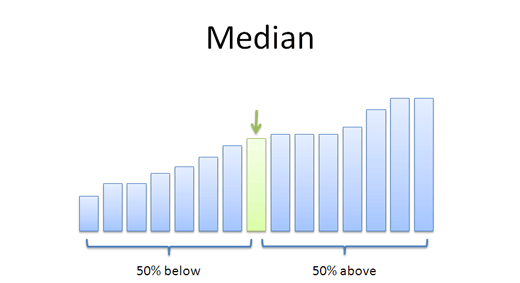
Living in Arizona, the news has been filled recently about teachers fighting for a better wage.  This has led to a lot of statistics flying around.  For instance, one article states the mean (average) teacher pay in Arizona is $53,560.  Another article states the median teacher pay is $46,949.  That is a pretty big difference.  Not only is one number 14% higher than the other, but there is a psychological effect when you, the reader (potential voter), see a number over $50K vs under $50K.  It’s the same psychological effect as a retailer selling more “widgets” because they were priced at $99.99 as opposed to a flat $100.  Well, should I look at mean or median?  It’s up to you, they are both correct statistics, but you need to understand the differences to make a decision based off one or the other.  I am currently reading Naked Statistics by Charles Wheelan (highly recommend ALL of his books on Statistics, Economics, and Finance) and he gives a perfect example of the difference, “imagine that 10 guys are sitting on bar stool in a middle-class drinking establishment in Seattle; each of these guys earns $35K per year, which makes the mean and median income for the group $35K.  Bill Gates walks into the bar.  Let’s pretend Bill Gate’s annual income is $1B (not the actual $11.5B it really is).  When Bill sits on the 11th stool, the mean (average) annual income for the group at the bar rises to $91M!”  Which of these do you think is a better descriptor of the story?  Were you in an exclusive bar full of millionaires or a bar down the street with some regular Joes that Bill Gates just happened to walk into skewing the average?  Outliers can skew the average.  Median numbers are taking all of the numbers and laying them in a line in order and taking the middle number.  If you have a group of people, you would want to use a median number to understand what represents the typical income as that means half of all people are below that and half are above that, but this number will NOT be skewed by extreme outliers like Bill Gates that change the story completely.
Median.png

Staying with this Red for Ed topic, the pro teachers group had a bill put on the ballot (that would be up for a vote in November) on some taxes that would increase for very high earners (the wealthy).  A group staunchly against this measure got it removed by arguing that the language “creates a significant danger of confusion or unfairness.”  On one hand, the group that got it removed wasn’t technically wrong, but it was a piece of shit thing to do.  The signatures were had and the people should have had their chance to vote, but because of confusion regarding the words describing the statistics, it was basically killed due to “technicalities.”  The issue here was that the bill would have said individual earners of >$250K per year, or couples of >$500K per year, would have their 4.54% tax rate increased to 8%.  The problem here was the wording.  The wording on the bill would have raised the tax rate on high earners by 3.46 percentage points.  However, points being the key word here, was never actually stated, but you could infer that just by looking at the numbers 8% and 4.54%.  A percentage point, by the way, is a unit of 1%.  In this case, the bill would have risen by (8%-4.54%) 3.46% points.  When you think about something going up 3.46% percentage (points) it doesn’t really seem that bad does it?  Now, if the bill would have said it is increasing taxes on the wealthy by 76% ((8%-4.54%)/4.54%) that paints an entirely different picture in your head.  Even if you absolutely hate rich people, that seems like an extreme increase.  What’s weird about this, is that both 3.46% points and a 76% increase are absolutely correct descriptions of what was happening.  Do you see how easily things can be twisted to fit a narrative?

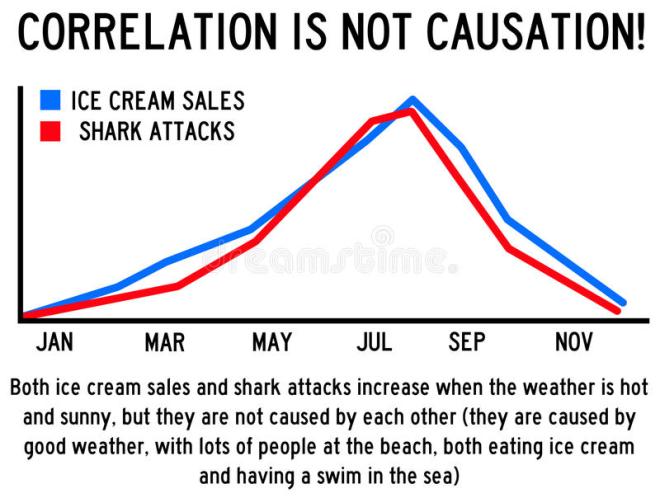
Statistics get infinitely more confusing when people try and “read between the lines” and link cause and effect.  You’ll often hear that correlation doesn’t equal causation, but what does that mean?  This is where statistics can veer away from science and become more of an art.  Did you know that the more ice cream you buy the more people get attacked by sharks?  Well obviously they don’t really have an effect on each other.  For instance, Shark attacks happen more frequently in the summer, when it’s hot, and people are swimming, and waters are warm for sharks and people to swim in.  Coincidentally, when it’s hot, people like to cool down with some ice cream.  It just so happens that if you graphed these two INDEPENDENT variables, you would see a perfect correlation, but that does not mean one is the cause of the other.
correlated-clipart-2.jpg

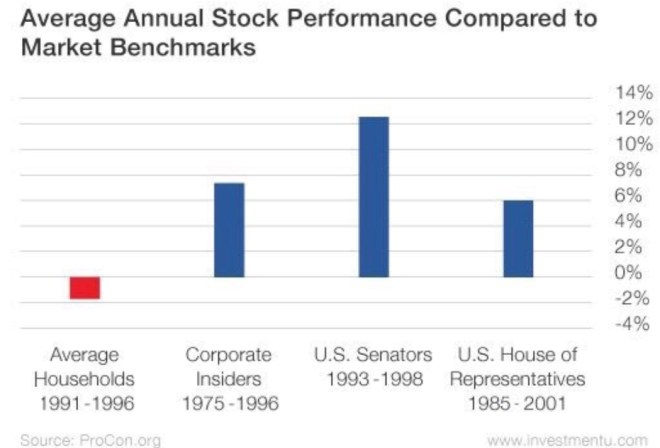
Some graphs don’t even try and hide how bad they are.  Here is one that someone posted while trying to make a point in a Twitter spat I just happened to come across.  Which person was right and wrong is not important, but the second I saw this it blew my fucking mind!  Without context of the argument, do you immediately see how bad this chart is?
Bad Chart

There has to be some comparability variable.  In this chart you have 4 independent groups.  No problem with that, but you would have to compare all 4 of them over the exact same time period, OR, the groups (population samples) would have to be the same, but over 4 different time periods to see how one group changed over different times.  You absolutely CANNOT compare 4 DIFFERENT groups over 4 DIFFERENT (random, not even the same length of years) time periods and gain ANYTHING other than confusion from this.  However, the person that posted this needed to prove a point, and to quote Morgan Housel, who recently had some excellent tweets about statistics, “The reason people abuse statistics isn’t because they can’t calculate standard deviations; it’s because stories that confirm your beliefs are more persuasive than stats and always will be.”  Now, I don’t know Morgan at all, but would assume he runs in a different intellectual group than the average American by assuming most people can calculate standard deviations, or even know what a standard deviation is, but the quote is still spot on when it comes to proving out what you already believe.  There takes a certain amount of self-awareness to have the ability to go in to something with an opinion and be perfectly ok, albeit shocked, when you are proven wrong by dissecting hard data.  If you keep cutting numbers to try and prove your point, then you are a part of the problem.
Dilbert.jpg

Lately plastic straws have been painted the pollution bad guy.  Social media has been in a rage about how harmful they are, and big business is very eager to announce they will comply and help (Disney, Starbucks, and restaurants all over announced bans).  However, the statistics are telling.  Many articles, AFTER the social media tidal wave had already done its job, reported on how meaningless plastic straws actually are in the grander pollution fight.  One Vox (purposefully picked as no one could claim they aren’t liberally biased) article stated, “on a global scale, straws would probably only account for 0.03% of total plastic waste by mass (Vox).”  I’m not going to argue with you if you want them banned, and I am very aware that decreasing pollution by even 0.03% is better than nothing, but I wonder if the articles were titled, “Hooray, plastic straws are banned, but the other 99.97% of pollution is still killing us!” people would be so proud of themselves today.  The point again is to do your research and think critically.  Statistics can be manipulated, artfully represented, or just flat out omitted if it means that person/group achieves their goals.  Businesses, by the way, ate the straw thing up because they have a huge expense savings now on plastic straws, which they gave to us for free (not revenue generating), do not have to decrease their prices, a result of said cost savings (pure profit increases), and get all the positive PR from making this very tough choice.

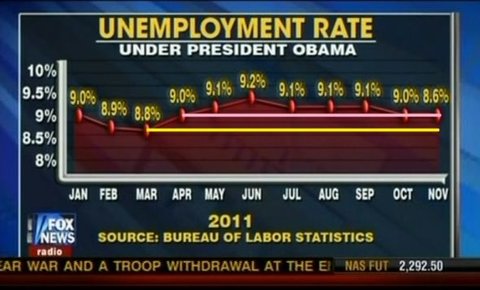
Side note; Fox News are PROs at manipulating statistics, just look at this chart.  Notice how the 8.6% in November is higher than Jan through Mar, and even with April, even though the number is the lowest one on the graph?  Also, the 9% in Oct and 9.1% in September are on two different bars although the key the left makes it look like each bar is about 5%.
Fox news

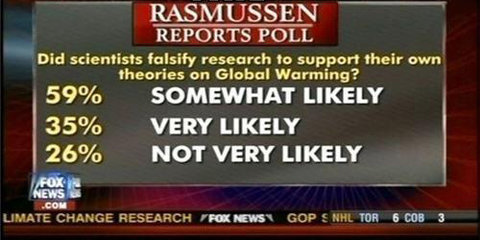
On this one, the numbers add up to (59% + 35% + 26%) 120%.  The irony being that they are calling out scientists for supposedly “falsifying data,” when the data used to prove that can’t possibly be correct.
Fxnews 2

Just remember, as midterm elections approach, quarterly earning calls come up, and the next wave of public outrage finds your social media wall, don’t be afraid to question it all.

SexPanther

Stock Buybacks…evil or misunderstood?

Lately the news has been awash with debates about Stock Buybacks/Repurchases.  As the, all too real, fight between Capitalism and Socialism (a topic that will be covered in-depth throughout future blog posts) commences.  Stock Buybacks have found themselves in the cross hairs as something that symbolizes everything EVIL about Capitalism (How often does a chance to use “Showcard Gothic” font come up?).

First, let’s discuss what Stock Buybacks are.  In simple terms, stock buybacks are when a company repurchases shares of stock that have already been released to the public.  These shares are repurchased by the company at market value per share.

If a company raises money (equity) in order to fund growth by selling their stock, why would a company ever want to repurchase their own stock back?

There are a few reasons a company may want to repurchase their stock.  Undervaluation of their stock, re-balancing ownership ratios, and the effect on key metrics such as Earnings per Share are a few.

Huh?

Ok, so if a company is projected to have $10M in Earnings (Net Income/Profit) and has 2 million shares out in the public, they are projected to have EPS (Earnings per Share) of $5 ($10,000,000 in earnings/2 million shares=$5 EPS).

But, ummm…why is EPS important?  Well, EPS is one of many financial indicators to tell you if a company is a good investment.  This, obviously tells you how good the earnings (Net Income/Profit) are per outstanding shares trading in the market.

When you own a share of stock, you own a piece of that business.  If the business decided to pay out all the profits it made to the stockholders, then EPS would basically tell you how much money you are getting for every share you own.  This is why EPS is important.

Of course, the world does not work that way.  A business needs to grow and adapt with the times, so they typically reinvest profits to keep growing the business in the hopes that future EPS are even higher.  EPS then becomes a representation of the potential money you could be making as a stockholder if they did pay out their profits.  Another time we will discuss Dividends which are when a company does in fact pay some of those profits out to shareholders, but not today.

Take a breather, we’re almost to the fun part.

Investors want to invest in businesses that are growing and profitable.  A positive EPS represents a business that accomplishes both of these things and indicates how much value the investor is getting.

So…back to our example.  Our business has projected earnings of $10M and has 2M outstanding shares of stock, but then decides to buyback/repurchase 1M shares of stock.  Their EPS just went from $5 (10M/2M=5) to $10 (10M/1M=10)!

Why the outrage over Stock Buybacks?  Well, this is where economics, business, and politics have a messy little menage-a-trois.  The main argument against stock buybacks are the assumption that every dollar of the business not paid out to shareholders via dividends, should be re-invested into the assets of the business, the employees working there, or R&D to help develop new streams of revenue.  When put like that, I have no problem with these ideas.  However, there is so much nuance to this discussion that blanket generalizations calling for government regulation, in my opinion, are dangerous.

One article in The Atlantic (Article here) argues that if companies were to forego stock buybacks and reinvest every dollar of net income back into wages, “Lowe’s, CVS, and Home Depot could have provided each of their workers a raise of $18,000 a year, the report found. Starbucks could have given each of its employees $7,000 a year, and McDonald’s could have given $4,000 to each of its nearly 2 million employees.”  However, lets unpack that sentiment for a moment.  What real benefit is it to the company to do that?  If every employee at McDonalds gets a $4,000 raise does that mean the number of times they forget my bar-b-que sauce will dramatically decrease?  Will Starbucks workers stop misspelling my name on my triple venti half-sweet non-fat caramel macchiato?  No, they fucking won’t.  The market sets value on things for a reason!  It would be nice for a business to choose to have a more social impact, but how much government intervention should we be ok with?  Should businesses not have to care about profits?  One major reason this thinking is scarily flawed is that anomalies occur.  What happens if I have record profits one year, but next year the economy tanks?  If I pay out dividends, that money is gone, but it is a one-time hit to my equity.  If I give everyone at my McDonalds a $4,000 raise, that is a reoccurring profit hit every year, and it compounds with annual raises, bonuses, etc.  If my profits tank the next 2 years and I have to reduce staff in order to stay profitable, I may now need to reduce my staff by 6 people to adapt to the decline in profits, as opposed to 1 person had I not given everyone “non-value added” raises.  That means more jobs will be lost (I made a spreadsheet to prove this theory out: McDonalds Example).  However, if I had repurchased shares of stock, and the next year we need to raise capital to fund investments because profits are down, I can re-release those repurchased shares to the public again, granted at a lower stock price, but it’s the safest action of the three in this scenario.

<All information for the McDonalds PDF was real financial information taken from here: (McDonalds Financials).>

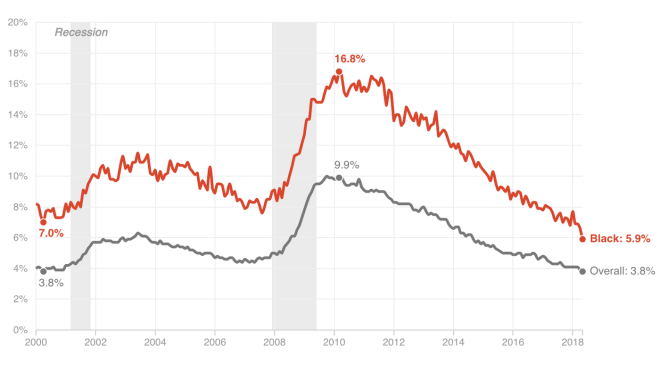
An article in the NY Times, boldly stated that companies should not be beholden to maximizing shareholder value, stating “The stranglehold of this doctrine of “shareholder-value maximization” over corporate decision making has been a leading cause of inequitable incomes, unstable employment, and sagging productivity (NY Times).”  Unstable employment and sagging productivity?  Really???  We are more productive now than we have EVER been and employment rates are at levels not seen since war time years when we had half the country working towards war efforts.

(Sorry, the best chart I found was comparing Black unemployment to all Unemployment)

Unemployment by Year

All-time high productivity starting to peak and reach it’s limits, but revenue keeps climbing…which means extra capital to spend elsewhere

Figure6

I will not argue that wages are not moving the way they typically do when employment is low and productivity is high, but I don’t think that stock repurchases are the boogie man causing this.  However, shareholders bear a lot of risk investing in companies, and like it or not should have value returned to them for taking on that risk.  Remember when we talked about how owning a share is basically owning a piece of the business?  Imagine you are a small business owner and you have a restaurant with 15 employees.  Your employees are all paid as well as every other restaurant for a 500-mile radius (so, at market value), if not a little higher and you have all new equipment (assets) that won’t need to be replaced for some time.  If you have record profits one year should you have to buy equipment that you may not currently need or give it back to the employees although they are already at maximum capacity with their job duties and cannot be any more productive?  As the business owner (you are basically a shareholder with 100% of the shares), you have risked everything to get this business running.  Emptied your savings, sleepless nights, learned the hard way what to do and not do as you got things running, you have risked it all and now someone is saying you don’t deserve a piece of the success for all of that risk.  Obviously, this is an extreme example, but shareholders of a business are putting in their hard earned money to fund a business.  They are taking a major bet, when they could just put it in a savings account, that it will turn out to do well and return some value to them.  You could argue it’s not like they are actually doing anything, but buying some stock, they aren’t having sleepless nights like in the small business example.  However, in a way that could be argued as even riskier.  They are betting on management they have never met to make decisions they have zero say in with money they are banking on to “maybe” return value one day.  If that isn’t risky then I am not sure what is.  It’s literally a bet, albeit it an educated one assuming you put some thought into why you want to invest in that business.  If I go to the casino and place a wager on a football game, I am placing a lot of money on a group of guys to go out there and play well and I have zero control over success or failure.  I get paid a lot of money back to me if I win, because I am taking on so much risk.  I could invest in treasury bonds that have little to no risk, but very small returns over a long period of time, but the risk I am willing to take on should be matched by the returns I get back if successful.  Additionally, shareholders use the returns to keep investing, “Capital flowing to…shareholders does not go down the economic drain: Shareholders use much of the cash, we know, to invest in smaller public and private firms, supporting innovation and job growth throughout the economy (Harvard Business Review).”

In a Seeking Alpha article, the author argued “For one, buybacks are a sign of short-termism among executives, the argument goes, boosting shareholder value without boosting the underlying value, profitability, or ingenuity of a given firm. Companies do not get better because of buybacks; it is just that shareholders get richer (Seeking Alpha).”  I will discuss my major issues with short-termism another day, but again I would argue that free markets should regulate themselves when it comes to buybacks.  Executives are paid a lot of money for a reason.  If they are using money that truly should be going towards investment in employees, assets, or R&D on share repurchases instead, these businesses will fail at some point.  That is the business cycle.  Snakes shed their old skin to allow for growth and remove parasites that are attached.  Free markets are the same.  Businesses fail and businesses succeed and if they are not adapting they will die and a new, more intelligently run business, will spring up in its place.  For this reason, I would argue stock buybacks are not replacing necessary investments because businesses would die if they were literally taking all of the dollars meant for reinvestment and only repurchasing shares.

These are the main reasons that stock buybacks being singled out are a little crazy to me.  I did not even mention that R&D spending has gone up year over year or that maybe companies left after the Great Recession were the leanest and most efficient, already weeding out those that poorly allocated capital.  However, this is coming up before the midterms and it is an easy target because a lot of people aren’t well versed in business finance or critical thought for that matter.  Additionally, you can then exacerbate the problem, by attaching it to Trump’s tax cuts and the fact that trickle-down economics never really works.  The problem is, this isn’t about one or the other.  Many companies are like Alaska Airlines, who used a lot of their tax savings to buy shares back (repurchasing 185K shares for $12M (Here) and also give out a $1,000 bonus to 23,000 employees ($23M in expense) on top of $118M in incentive bonuses (Here).  Apple is spending $100B in Stock buybacks.  When have you ever not seen Apple on the lists of best companies to work for (Apple one of only 3 companies rated ‘best places to work’ for 10 years) or someone say I wish Apple spent more on R&D because they just aren’t innovative?  Yea, me either.  However, the more nuanced spending stories don’t generate flashy headlines or political opposition.  I could be wrong, and if you have counter opinions, let’s talk about it, but stock buybacks seem to be the new Frankenstein (pronounced Fronck-En-Steen) and in today’s overly outraged society politicians are all too eager to hand out the pitchforks and torches while journalists point to his house.

Young-Frankenstein-1

My (current/evolving) top 5 traits of great leadership!

I was debating what this first post would be about.  I want this to be an all-encompassing business, finance, and economics blog, but where to begin?  In light of some conversations I have been having about leadership recently and seeing news headlines (ie…Elon Musk and Elizabeth Holmes), I have decided leadership will lead (see what I did there) off my blog.

What makes a good leader different from a bad one?

Here are my (current, always evolving) top 5 traits of a great leadership:

Transparency:

The longer I work, the more I believe in “Radical Transparency/Radical Truth.”  I have only made it about 1/3 of the way through Ray Dalio’s book “Pinciples”, but the parts that have stuck out for me the most are Ray’s views on radical transparency and truth.  Ray isn’t alone, as I first heard about this while doing reports on Netflix and their founder/CEO Reed Hastings.  Lately, Hubspot has been in the news discussing their “radical” culture.  I have a paragraph at the bottom of the blog regarding Ray and his book in case you would like to know more, but the best concise definition of Radical Transparency I have seen is from Gene Hammett (Gene’s article here) stating, “Radical transparency” is creating a culture that is direct and honest in communication and sharing of company strategies so that all people are trusting and loyal to the continuous evolution of the organization. For leaders, radical transparency is a way to build trust with their employees.”  When it comes to the truth part of the equation, in the book, Ray states “I want independent thinkers who are going to disagree.  In order to be successful, we have to have independent thinkers, so independent that they’ll bet against the consensus.  You have to put your honest thoughts on the table.”  The worst bosses I have had are the ones that shoot down the ideas of smart people because it wasn’t “their” idea.  Even less effective are the information hoarders.  This is an ego play and it is bad for the culture of any business trying to grow successfully.  These people should be weeded out immediately and replaced by leaders that not only encourage free thought, but also push the boundaries of those thoughts further than the employee thought they could reach.  In addition, the leader should let the idea creator have their moment to shine.  The best leaders are the ones that measure their own success on the successful advancement of those under them, not on a specific metric or two for quarterly reporting.  Metrics are important, but don’t sacrifice long term growth and big picture success for short term results or you will never be satisfied and will have a lot of turnover from great people.

The cons to radical transparency is that not everyone can operate this way.  Employees need to display vulnerability and be able to handle unfiltered honesty.  Leaders need to foster the idea that any feedback needs to truly be a learning experience.  In this culture there is a loop of honest feedback about how everyone is doing.  Ray went so far as to have baseball cards made for all of his employees which listed their strengths and their weaknesses based off the feedback.  This also means people might not be right for certain jobs and if they can’t be placed somewhere that plays to their strengths they will need to be filtered out.  This can be hard for people who already have self-doubt or just aren’t mature enough to handle tough conversations, but in the end I believe everyone benefits from this system.


Ability to Manage Up/Lead Down simultaneously:

This is probably the most underrated item on this list.  When people think of leadership they tend to think of downstream leadership.  How does a leader communicate to the people that answer to them?  How do they adapt to the different personalities on their team?  Far too few people think about the art of “managing up” and how this ability truly makes you a great leader.  Anyone can be a “Yes man (woman),” but it takes a special person to play the part of buffer for their team and still be able to satisfy those above them.  Harvard Business Review has a terrific article with tips and tricks for managing up different types of bosses (HBR Article).  Managing up is having the ability to redirect your boss in a way that won’t upset them.  Understanding how they operate and anticipating their needs is key.  Being able to thoughtfully push back on assignments if it may overload the team or asking why to get a better understanding of how certain projects are adding value.  My favorite bosses are the ones where I have said, “Why am I doing this?  Who reads this spreadsheet?  I don’t even see how this is adding value other than it’s what has always been done,” (obviously those statements said in a non-confrontational way) then having them talk to their leader and come back and say, “You’re right, this isn’t really adding any value.  What can we replace it with that will?”  THAT is how you manage up and lead down simultaneously.  We are capable adults and should be treated as such!  If your boss is too afraid of rocking the boat that they won’t push back above them or take a stand for you then they are a bad boss, full stop.  Leading down is the ability to see the big picture and organize tasks (talked about below) while simultaneously updating executive leadership on progress, successes, and pitfalls that may lead to changes which require push back.

Psst…if you want to know the most effective way to manage up, ask your local Executive Assistants.  They are PROs at managing up.

Organization:

This one is relatively straightforward.  Great leaders are organized.  I don’t think it is possible to be a great leader and not be organized.  Now, before you say anything I am referring to leadership in the sense of most executive leadership.  If you are a true visionary that founded an amazing company, this probably doesn’t apply, but I guarantee they have employed people who are excellent at organization and that is why they were able to scale successfully.  When it comes to organization, it is important to understand what everyone has on their plate currently, what the due dates are, and other projects waiting in the pipeline once the current ones are finished.  If there is a project missing deadlines, you need to understand why and be able to effectively communicate that to leadership above you (managing up), and jump in and help if the deadline is absolutely static.  I will say, when it comes to organization, and multitasking, in my opinion, women are far superior to men.  They’re also better at opening up communication so people are not afraid to say this won’t be done in time.  This is purely opinion from experience, but there are a lot of statistics that show this to be true (Article here).  This is not an excuse for poor organization, if you want to be a great leader it is something you will need to work on.  I tend to be singularly focused and use methods like time blocking to organize my tasks and take advantage of my strengths.  This is my biggest construction area and has been for some time.  It is why I was happy to move out of accounting and into a corporate finance which allows for more flexibility with projects and is less compartmental.

One of my bosses went so far as to have a notebook with color coded tabs and color coded post its.  It looked like something a middle-school kid kept in a trapper-keeper, and people would joke with her about it, but guess what?  It fucking worked!  She had an answer for damn near any question regarding financials or project statuses, on the spot, everywhere she went.  It was amazing how dialed in she was and she fully admitted she had a major weakness at one time when it came to organization and this is what worked for her.  She was self-aware enough to recognize her weakness and adapted by finding something that worked for her.  Great leader.


Big Picture Thinker:

So maybe the last paragraph made men unhappy, but now I will piss the women off too.  Let me preface by saying these are overarching personal observations and do not represent anyone in particular, unless I am talking about a boss I have had, you might not be represented in my very small sample size.

I do think women are more organized, better multi taskers, and more detail-oriented.  However, a lot of people think you are either a “details person” or a “big picture person.”  So if men are not as good with the details, they may be better at the big picture?  I have no idea, most of my bosses have been female, but I will say when I am in meetings men talk the most.  Men, in my professional experience, are less afraid to share grandiose ideas and less afraid to fall flat on their face at a meeting, which might lead to the idea that they are better big-picture thinkers.  Here is a Huffpost article on our different brains as I don’t want this to focus on sex (Huffpost article).  Quick side not before moving on, this is why a company with a healthy mix of gender/race diversity will statistically always perform better than a homogeneous one.  You need detailed AND big picture thinkers, but these are nuanced topics for another time.

The best leaders have the ability to see the big picture.  At some point you need to break away from the data grind of daily activities and zoom up from the top level to see how the big levers move up and down.    This also means you need to trust the people below you to do their job efficiently and let them do the heavy lifting while you look far into the future.  One of my favorite recent quotes is from Jeff Bezos, CEO/Founder of Amazon, at a conference in 2017, “When somebody … congratulates Amazon on a good quarter … I say thank you.  But what I’m thinking to myself is … those quarterly results were actually pretty much fully baked about 3 years ago.  Today I’m working on a quarter that is going to happen in 2020. Not next quarter.  Next quarter for all practical purposes is done already and it has probably been done for a couple of years.”  That is amazing, because while most leaders are thinking about their annual goals to hit their bonus or what they can do quickly to turn around their quarterly earnings in the next 90 days, Bezos doesn’t give a shit about short-term.  That was a big example, but anyone can think big picture.  Any time you are tasked to something you should not just learn the mechanics of it, but learn the purpose.  How does this affect our numbers or goals?  Where does this fall in the grand scheme of things?  If you can teach someone to do a job, but can’t tell them why they are doing that job then you need to become a better big picture thinker.

Another way to think of this is Left Brain vs Right Brain.  A good leader can identify their strengths and weakness here and hirepeople around them to balance them out while fostering those with like minded brains to reach their potential.

nDgrF

Ability to Adapt:

So many people fight change, but in order to be truly successful, you will need to embrace, and encourage change.  The world is moving faster than ever before.  Your education is no longer finished after High School or College, but life-long learning is the new wave of successful thinking.  We are all going to need to adapt to changing economics, evolving technology, and workplace politics.  Don’t complain about it.  Embrace it, carve it in to something that benefits you before it swallows you.  If you have a leader that says you need to do something because that’s what has always been done, run!  Be wary of anyone who rails when a new software rolls out.  NO ONE likes to learn new software, but the company invested in it and is implementing whether you like it or not.  The options are to complain and circumvent using it for as long as possible or to embrace it, because a semi-expert in it, and be the one everyone says you should go to if you have a question.  That’s how you lead by example and set the tone for those under you.  If you whine and complain, that will give your subordinates and coworkers free will to do the same.  Do you think your boss will want to promote you then?


Parting notes:

For those unfamiliar with Ray Dalio (his book, so far, is a must read), he is the founder of Bridgewater Capital, a hedge fund which manages aver $160B in assets.  Dalio’s own net worth is around $17B and he is one of the most highly regarded people on Wall Street.  Ray has made a ton of money, lost it all, learned from his mistakes, rebuilt it, and in doing so was one of the few firms that successfully navigated the 2008 financial crisis.  I will probably allude to “Principles” many times throughout this blog as it appears to be a 550-page masterpiece on Ray’s thoughts about life and work, which will be followed up with a 2nd edition in the future on Ray’s thoughts about Investing and Economics.  In addition to the books, he has some great videos that break down some of these principles and some of his thoughts on economics in very cool, easy to understand ways.

When speaking about Netflix’ culture, a new book from Patty McCord came out titled “Powerful: Building a Culture of Freedom and Responsibility.”  Patty was the Chief Talent Officer at Netflix during their most pivotal growth stage and I have this on my list to read.  If any readers of this blog have read it, I would love to hear your thoughts.  I have heard her on a few podcasts and it was fascinating.


What are your thoughts on leadership?  Did I miss any?  What are some experiences, good or bad, that you have had?

Welcome to my page!

This is the first post here for Fidel Cashflow (not my real name and YES, I understand the irony).

This site will be dedicated to anything that is financially related, because CREAM (Cash Rules Everything Around Me (us)).

Any money-related topics including, but not limited to: Investments, Economics (sometimes this will skirt around politics, but I will keep all opinions objective, and if I don’t, please call me out), Corporate, Personal, Taxation, or Excel Modelling.  If Finance is a part of it, we will try to touch on it.  Some of these topics I feel like an expert in.  Some of these things, I don’t know a damn thing about, but I will be honest about my level of knowledge and thought process regarding these topics.

I am going to keep it authentic on here.  I will swear.  I will crack jokes.  This is a not a formal buttoned up space, we have enough of those in life.

This is not a money-making venture for me, but an opportunity to meet like-minded individuals and use this platform as a sounding board.  If a community grows from this, we can grow the platform from there, but until then I will be researching, investigating, and learning from you AND with you.

Comment, question, and argue with me.  Let’s grow and teach each other.  That’s how we all get better!

Thanks for stopping by,

$FC$